Know how risky your health data is
before it moves.
Seiba Risk Scanner is an open-source toolkit that turns sensitive data detection into a full privacy risk assessment, for tables and clinical text, before data goes into AI, analytics or a partner’s hands.
 Beyond detection
Detection is only the beginning.
Good tools already find names, dates and record numbers in health data. Before that data moves into an AI system, a research dataset or a partner’s environment, your team still has harder questions to answer.
Where it fits. After sensitive data has been found, and before the dataset is used or shared.
- 01How serious is the privacy risk?
- 02Which datasets, records or fields need review first?
- 03Where is the exposure concentrated?
- 04How likely is it that someone could be re-identified?
- 05Which de-identification approach fits how the data will be used?
- 06How much useful information is lost once it is anonymized?
- 07Can every decision be explained and audited later?
How it works
Every assessment follows the same six steps.
The plan is written and explained before any data changes. Your team reviews it, then applies it.
Identify
Find names, dates, record numbers and other sensitive details in tables and clinical text.
CSV · tabular exports · clinical notes · lettersQuantify risk
Measure exposure across the whole dataset, not one finding at a time.
Exposure Index · severity · review queues · re-identification indicatorsExplain
Show what was found, why, and the reasoning behind each recommended action.
Detector evidence · confidence · provenanceOptimize
Choose a de-identification strategy that meets your privacy goals and keeps the data useful.
Configurable privacy objectivesApply
Run the plan across tables, documents and notes, with each repeated identifier replaced the same way.
Policy-driven de-identificationMeasure
Check the privacy risk that remains, and how much useful information you kept.
Residual exposure · analytical utilityIn the toolkit
Built to be explained, configured and run on real data.
It works the same way on structured exports and on free-text clinical documents, so one assessment covers the whole dataset.
Risk you can see across the dataset
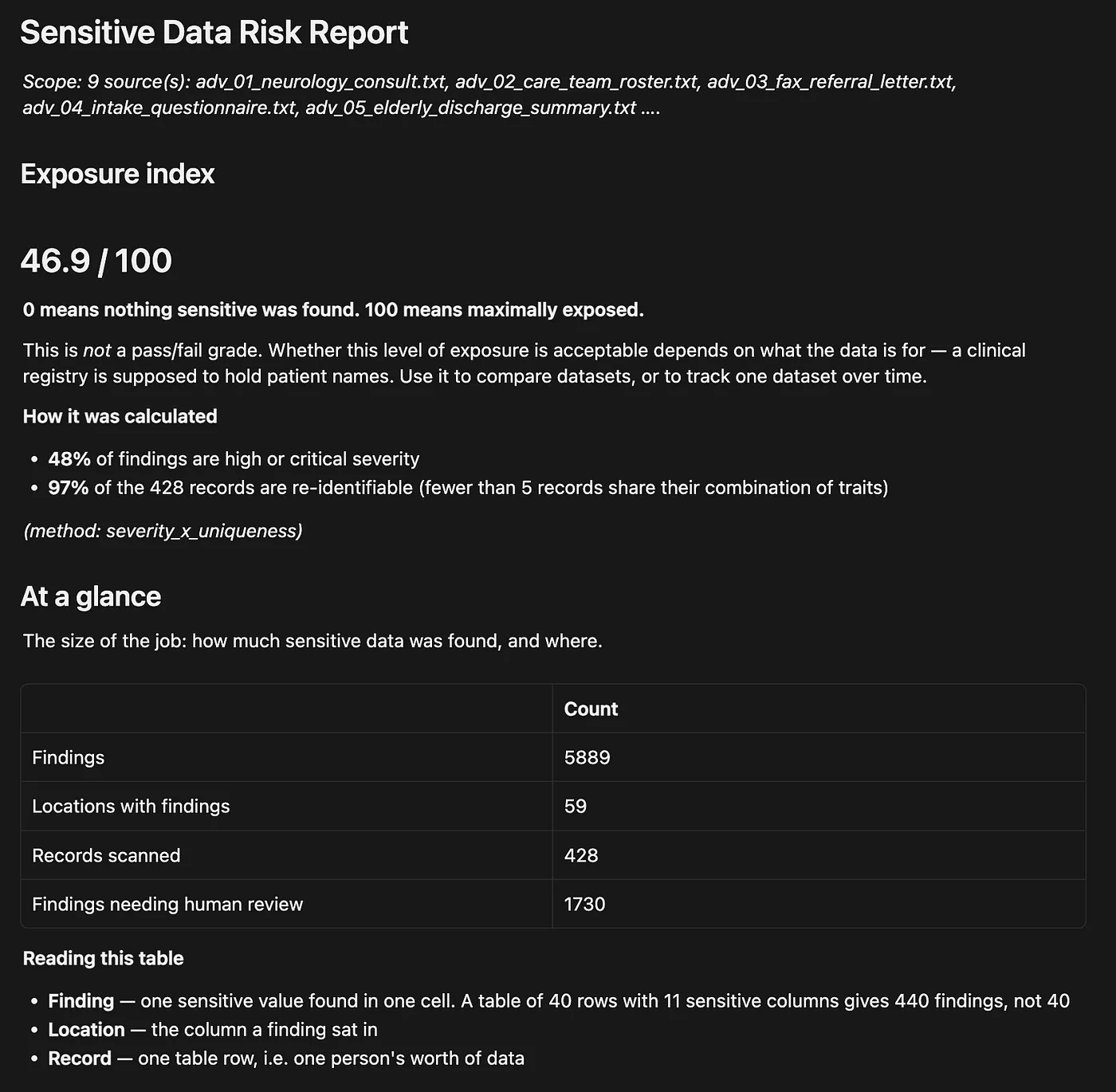
See where privacy exposure is concentrated and which records need review first, instead of a flat list of findings.
Exposure Index · severity distribution · review queues · privacy heatmapsA reason behind every decision
Each recommended action records what was found, why it was classified that way, which policy decided it and what replaces it.
Evidence · confidence · provenance · replacement strategyA plan before any change
The de-identification plan comes first. Once approved, it runs across tables and documents automatically.
Policy-driven de-identificationPrivacy balanced with usefulness
Not every sensitive value needs the same treatment. Optimization profiles let you weigh privacy against what the data still has to do.
Utility-aware optimizationPolicies you control
Keep specific clinical concepts, keep a year instead of removing a date, or change the default for any entity type, without touching code.
Configurable policies · editable ontologyWhole folders, one report
Point it at a folder of mixed tables and documents and get one consolidated report instead of reviewing files one by one.
Patient datasets · lab exports · clinical notes · consultation reports · referral lettersSeiba Risk Scanner is one part of one pillar, released as open source. Seiba Pulse watches all seven pillars, continuously, inside your environment.
Seiba Risk Scanner
Start with the code and the examples.
Full documentation is being written. Until then, the repository and its examples are the best place to begin.